How I Journal the Asma ul Husna and How the Names of Allah Changed My Worship
There is a practice I keep coming back to, no matter how busy life gets, no matter how full my days are with six children, homeschooling, a home to run, and a business to manage. It is not complicated. It does not require hours of free time. But it has done a lot for my connection with Allah SWT over many other things I have tried.
It is journaling the Asma ul Husna, the 99 Beautiful Attributes of Allah SWT, in a notebook.
I want to share this practice with you today, not as a productivity tip or a spiritual hack, but as something deeply personal. Because the truth is, learning Allah's Names through journaling has made me fall in love with Allah SWT in a way I did not expect.
It has made me trust Him more, rely on Him more deeply, and call on Him with a confidence and intimacy that I did not have before. And I want every Muslima reading this to have that too, inshallah.
Be sure to also read my other posts in this series on Asma ul Husna:
99 Names of Allah: Meaning, Benefits, and a Complete Guide for Muslimas
How to Memorize the 99 Names of Allah: A Practical Guide for Busy Muslimas
Why I Started Journaling the Names of Allah
Like many of us, I knew the Names of Allah existed. I had heard them recited beautifully in nasheeds. I had seen them on the walls of masjids. But knowing them in that distant, decorative way is very different from knowing them in your heart, the way you know the face of someone you love.
I began this journaling practice because I wanted to truly know Allah SWT. Not just know about Him, but know Him. His character and His qualities. The way He shows up in my life every single day in ways I had not been paying attention to before.
And what I discovered changed everything.
When you sit down with one Name of Allah and really write about it, think about it, look for it in the Quran, reflect on it in your own life, something opens up in your heart. You begin to see Allah SWT everywhere. In the meal on your table. In the child who came home safely. In the door that opened when you thought every door was closed. In the moment of unexpected ease in the middle of a tough day. This is what it means when Allah says:
"And to Allah belong the best names, so call upon Him by them." (Quran 7:180)
You cannot truly call on Him by His Names until you know them. And you cannot truly know them until you have sat with them, one by one, with an open heart and a willing pen.
What Allah's Names Have Done for My Heart
Before I share the practice itself, I want to share what it has given me, because I think this is what will make you want to begin.
1. It has made me feel closer to Allah than I ever have
When I know He is Al-Latee, The Gentle, The Subtle, I notice His gentleness in my day. The small kindnesses. The quiet provisions. The things that worked out without me even asking. Suddenly, I see Him everywhere, and my heart is full of Him.
2. It has made me rely on Him completely
When I know He is Al-Wakeel, The Trustee, I can genuinely hand my worries to Him and mean it. Not just say the words but feel the release of truly trusting that He has it. This is not something I could have done before I knew this Name deeply.
3. It has transformed my duas
Instead of a general "Ya Allah help me," I now call on the specific Name that speaks to my need. When my child is sick, I call on Ash-Shafi. When money is tight, I call on Ar-Razzaq. When I feel lost, I call on Al-Hadi. My duas feel like conversations now; real, intimate, specific conversations with the One I know and love and trust.
4. It has given me the most profound comfort in hard times
There is a hadith qudsi that moves me every time I read it. Allah SWT says:
"I am as My servant thinks I am. I am with him when he makes mention of Me. If he makes mention of Me to himself, I make mention of him to Myself. And if he draws near to Me a hand's span, I draw near to him an arm's length. And if he draws near to Me an arm's length, I draw near to him a fathom's length. And if he comes to Me walking, I go to him at speed." (Bukhari & Muslim)
SubhanAllah, He comes to us running when we walk to Him. He draws near to us a fathom when we draw near to Him an arm's length. This is who Allah SWT is. This is what His Names reveal to us: a Lord who is not distant, not indifferent, not too busy for us. A Lord who is running toward us the moment we turn toward Him.
5. It has filled me with a love for Allah that I did not know I was capable of
He is Al-Wadood, The Most Loving. He is Ar-Rahman, The Most Merciful. He is Al-Kareem, The Most Generous. He is Al-Ghafoor, The Most Forgiving. The more I sit with these Names, the more I understand that He loves His servants in a way that surpasses any love we have ever known or will ever know. And that understanding, truly feeling it, not just knowing it intellectually, is the most beautiful gift this journaling practice has given me.
He is the only One Who will never disappoint us. Never leave us. Never ignore us. Never tire of us. Never run out of mercy for us. Never stop loving us. In a world where every human relationship carries the possibility of loss and pain, knowing Allah SWT through His Names is the most stabilizing, anchoring, peace-giving thing I have ever done for my soul!
My Journaling Practice
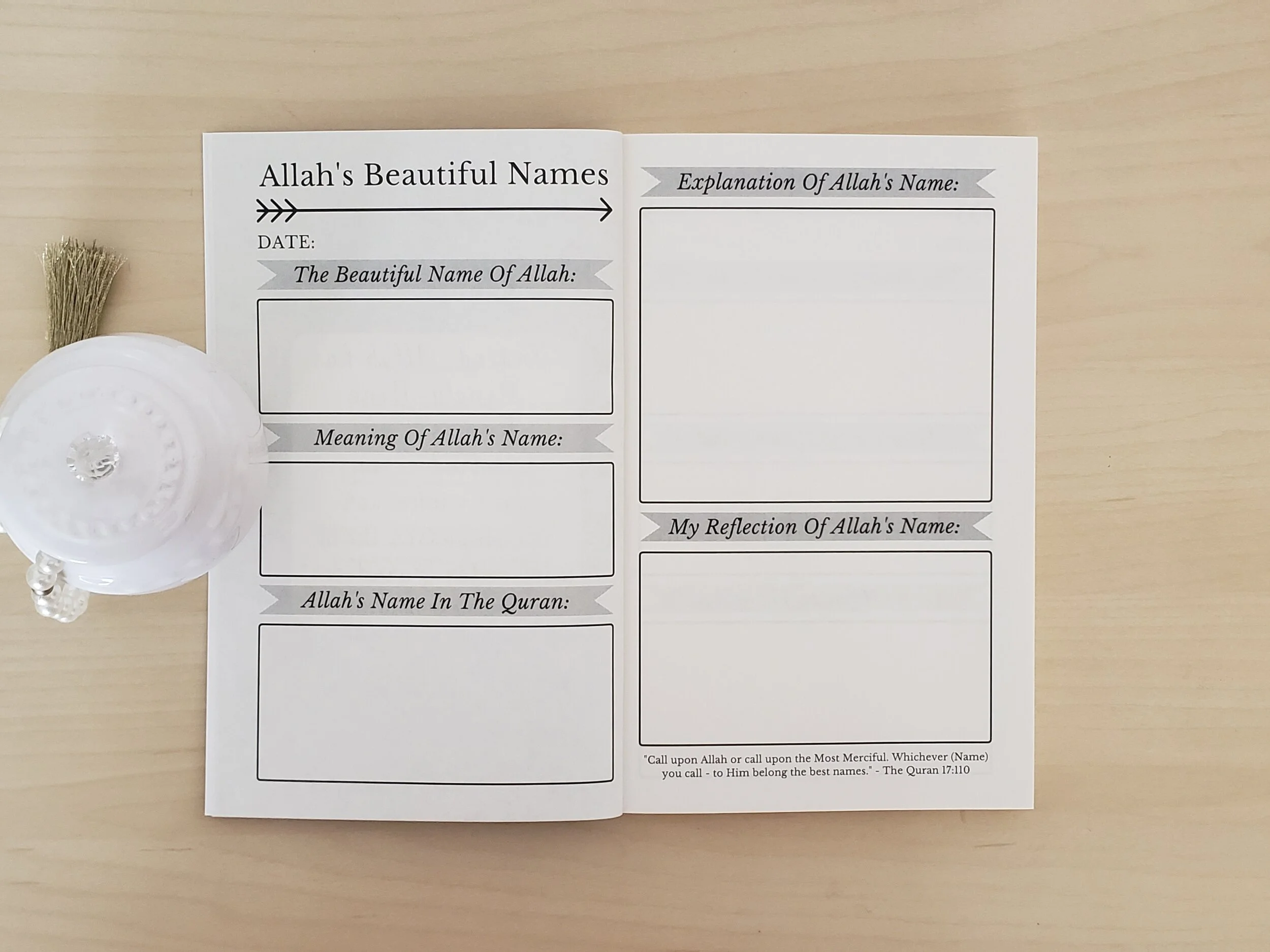
I use my Asma ul Husna Journal, which is a dedicated journal I designed specifically for this practice, with structured pages that walk you through each Name step by step. However, you can use any plain notebook if you prefer.
Here is exactly how I use it:
I aim to journal daily, but every Friday is my non-negotiable
Friday is the most blessed day of the week, and I protect this practice on that day no matter what. On other days I journal when time permits—sometimes during the quiet after Fajr, sometimes during the times my children are not home, sometimes in the evening. But Friday mostly happens. If you are just starting out, I recommend beginning with just Fridays and building from there.
I take one Name per session
I do not rush through multiple Names in one sitting. One Name, one session, full presence. This is not a checklist exercise, it is an act of worship.
Here is what I write for each Name:
1. The Name in Arabic and transliteration
I write it out by hand. There is something about writing the Name of Allah that feels sacred and sets the tone for the session.
2. The meaning
I write what the Name means in English, in my own words as much as possible. Not a copy-paste definition but my own understanding of it.
3. Where it appears in the Quran
I look up an ayah where this Name appears and write it out. This is one of my favorite parts because suddenly the Name is not just a word, it is alive in the Book of Allah. My published journal has a dedicated section for this, and it always gives me chills to see how Allah SWT uses His own Name in context.
4. The explanation
I write a short explanation of the Name, like what the scholars say about it, what it means in terms of Allah's character, how this quality of His manifests in creation and in our lives. I get this from podcasts and Islamic websites.
5. My personal reflection
This is the heart of the practice. I write about what this Name means to me personally. Where have I seen this Name of Allah in my life this week? How does knowing this Name change the way I see my situation? What dua does this Name inspire in me? This section is different every time, and it is where the journaling becomes truly transformative.
My journal pages are designed in a minimalist bullet-style format that is structured enough to keep me focused but open enough for my own creative expression. I sometimes add colors, decorations, or little notes in the margins. It becomes something beautiful and personal that reflects my unique journey with Allah's Names, alhamdulillah.
Read my article on: How to Journal the Names of Allah With Your Children
How to Begin If You Have Never Done This Before
If this practice is new to you, here is the simplest way to start:
1.Prepare your journal
The Asma ul Husna Journal has everything structured for you so you don't have to figure out what to write, just open it and begin. For your children, the My Asma ul Husna Journal does the same. Otherwise, you are more than welcome to use my structure in a plain notebook you already own.
2. Start with Ar-Rahman
There is no better Name to begin with than The Most Gracious, The Most Merciful. It is the Name Allah SWT begins His own Book with. Sit with it and write about it. Ask yourself, where have I experienced Allah's Rahman this week? You will be surprised by how much you find.
3. Commit to a time
Just journal on Fridays to begin or any other day of the week you prefer. One Name, one page, and fifteen to thirty minutes. That is all you need to build the habit gently and let it grow naturally from there.
4. Make dua before you begin
Before you open your journal, say: "Ya Al-Aleem, teach me what I do not know. Ya Al-Lateef, open my heart to understanding Your Names. Ya Al-Wadood, let this practice deepen my love for You." Begin with intention, and Allah SWT will bless the effort, inshallah.
Enjoy Your Journaling
My dear sister, we live in a world that is constantly pulling our attention in a thousand directions. Our phones, our responsibilities, our worries, our endless to-do lists. In the middle of all of that, sitting down with the Names of Allah is an act of resistance, a declaration that knowing your Lord matters more than the noise everywhere.
And He is worth knowing. He is worth every minute you give to this. Because the more you know Him, the more you will love Him. And the more you love Him, the more you will trust Him. And the more you trust Him, the more peace you will find in this life, no matter what it brings.
He is Al-Hayy, The Ever-Living. He is Al-Qayyoom, The Sustainer of all. He is here, He is near, He is listening, and He is running toward you every time you take a step toward Him.
So pick up your pen, dear sister, and just begin—even if all you do is write out His Name and learn the meaning..
Get Your Journals
The Asma ul Husna Journal for Adults and Teens — structured pages to journal each of Allah's 99 Names with space for Arabic, meaning, Quranic reference, explanation, and personal reflection.
My Asma ul Husna Journal for Kids — a beautifully simple kids' version for ages 5-12 to learn and reflect on Allah's Names with creative freedom.
Explore the Full Series on the Names of Allah
Salam, I’m Zakeeya!
A Muslim wife, mother of six, author, and mentor dedicated to helping Muslimas find peace, purpose, and barakah in their everyday lives. Since 2011, I've been sharing practical Islamic guidance on wifehood, motherhood, homemaking, and spirituality to help women like you navigate life's challenges with more faith and less overwhelm. If this post resonated with you, I'd love to have you join our community and say salam, grab free Islamic resources in the Member Vault, and explore my books, journals, and mentoring—visit my About Page. May Allah bless your journey! 🤍
Get Support For Your Struggles

You don’t need to suffer alone
Life’s tough, but so are you. You simply need direction and help from someone experienced, empathetic, and understanding.