Teaching Your Kids the 99 Names of Allah: A Muslim Mother's Guide

One of the greatest gifts we can give our children is to help them truly know Allah SWT. Not just know about Him, but know His mercy, His strength, His gentleness, and His love. And one of the most beautiful ways to do this is through His 99 Names. The Prophet SAW said:
"Allah has ninety-nine names, one hundred minus one; and whoever memorizes them will enter Paradise." (Bukhari & Muslim)
Teaching our children the Asma ul Husna is not just about memorization; it is about nurturing their hearts to love Allah SWT, to recognize His attributes in their everyday lives, and to call upon Him with confidence and intimacy. When children grow up knowing Who Allah is, they develop a relationship with Him that no hardship can shake and no doubt can easily break, inshallah.
I did this with my own children when we were homeschooling, and I can tell you from experience that it is one of the most fulfilling things you can do as a Muslim mother. This post brings together everything I have learned along the way.
Why This Matters More Than You Think
We live in a world that is constantly competing for our children's hearts. Screens, trends, and peer pressure pull them away from Allah SWT from a very young age. The most powerful antidote to all of that is not more rules or more restrictions. It is knowing Allah.
When a child knows that Allah is Al-Hafeedh, The Protector, they feel safe in a way that no amount of parental reassurance can fully give. When they know He is Al-Wadood, The Most Loving, they carry a sense of being loved that does not depend on what anyone else thinks of them. When they know He is Al-Lateef, The Gentle, they trust that even in hard moments, their Lord is being gentle with them in ways they cannot see. The Prophet SAW said:
"Every child is born in a state of fitrah (pure natural disposition). Then his parents make him a Jew, a Christian or a Magian." (Bukhari & Muslim)
Our children are already inclined toward Allah SWT by their very nature. Our job as mothers is to nurture that inclination and give it language, practice, and beauty.
1. Make It Visual
Children learn best when they can see and interact with something. Making the Names of Allah visually present in your home and your child's learning space is one of the simplest and most effective things you can do.
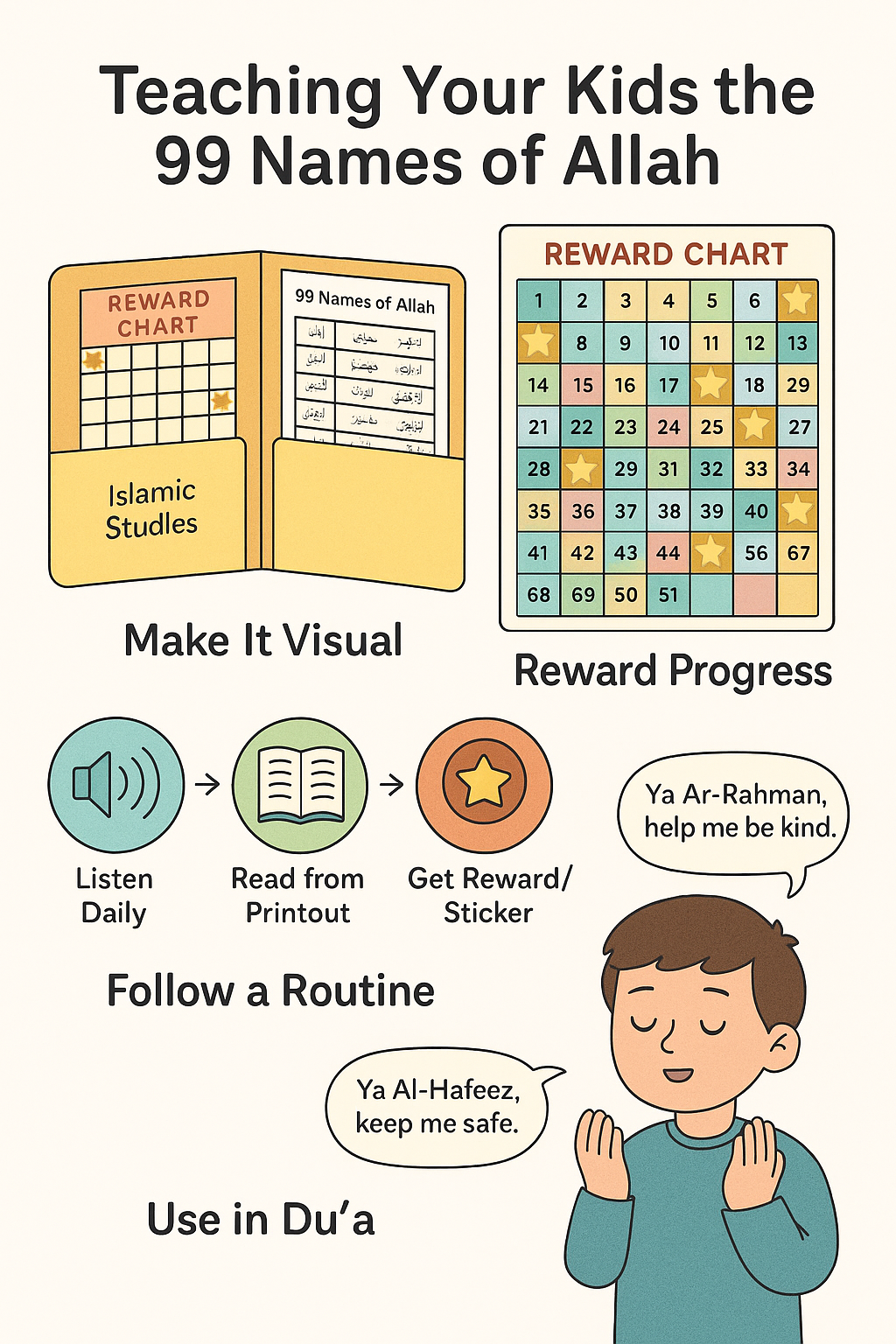
Print out the 99 Names in a clear, easy-to-read format and create a simple binder or folder for each child labeled Islamic Studies. Place a reward chart in one pocket and the printed Names of Allah in the other. Use stickers, stamps, or checkmarks so your child can track their progress and feel a sense of accomplishment. Children are deeply motivated by seeing their own growth.
You can also write the Name of the week on a piece of paper and stick it on the fridge, or somewhere the whole family will see it throughout the week. Every time a family member passes, say the Name once. By the end of the week, it will be memorized without anyone even trying, mashallah.
2. Make It Audible
Repetition through listening is one of the fastest ways children memorize anything, and the Names of Allah are no exception. Play recordings of the 99 Names regularly in your home and car.
In the car on the way to school or errands. At home during playtime, mealtime, or before bed. Through apps or YouTube recitations. The key is consistency; even 10 to 15 minutes of daily listening can make a remarkable difference, and children often memorize this way effortlessly without even realizing they are learning.
A dedicated app for the 99 Names makes this easy. Search for an Asmaul Husna app with Arabic, meanings, audio recitation, and maybe a quiz feature. There are also beautiful nasheeds available for free on Spotify whereby the artist sings Allah’s names in a heartfelt song, so you can also do search there.
3. Teach Pronunciation and Meaning
Once your children can recite the Names, guide them in proper pronunciation and help them learn the English meaning. This is where memorization becomes connection. The Names are no longer just beautiful sounds but windows into who Allah SWT is.
For example:
Ar-Rahman — The Most Merciful, The One who wills goodness and mercy for all His creatures.
Al-Ghaffaar — The Great Forgiver, The One who forgives again and again.
Al-Hafeedh — The Protector, The One who protects whoever He wills.
Take it slowly. One or two Names biweekly or per month is more than enough. Depth matters far more than speed. A child who truly knows ten Names of Allah is far richer than a child who can recite all 99 without understanding.
Encourage your kids to also use these Names in their duas in ways like:
"Ya Ar-Rahman, have mercy on me."
"Ya Al-Ghaffaar, forgive me."
"Ya Al-Hafeedh, protect me today."
When a child makes dua using a Name of Allah they have just learned, everything comes together—the knowing, the feeling, and the calling on Him. That is the complete practice in one beautiful moment.
4. Journal the Names of Allah Together
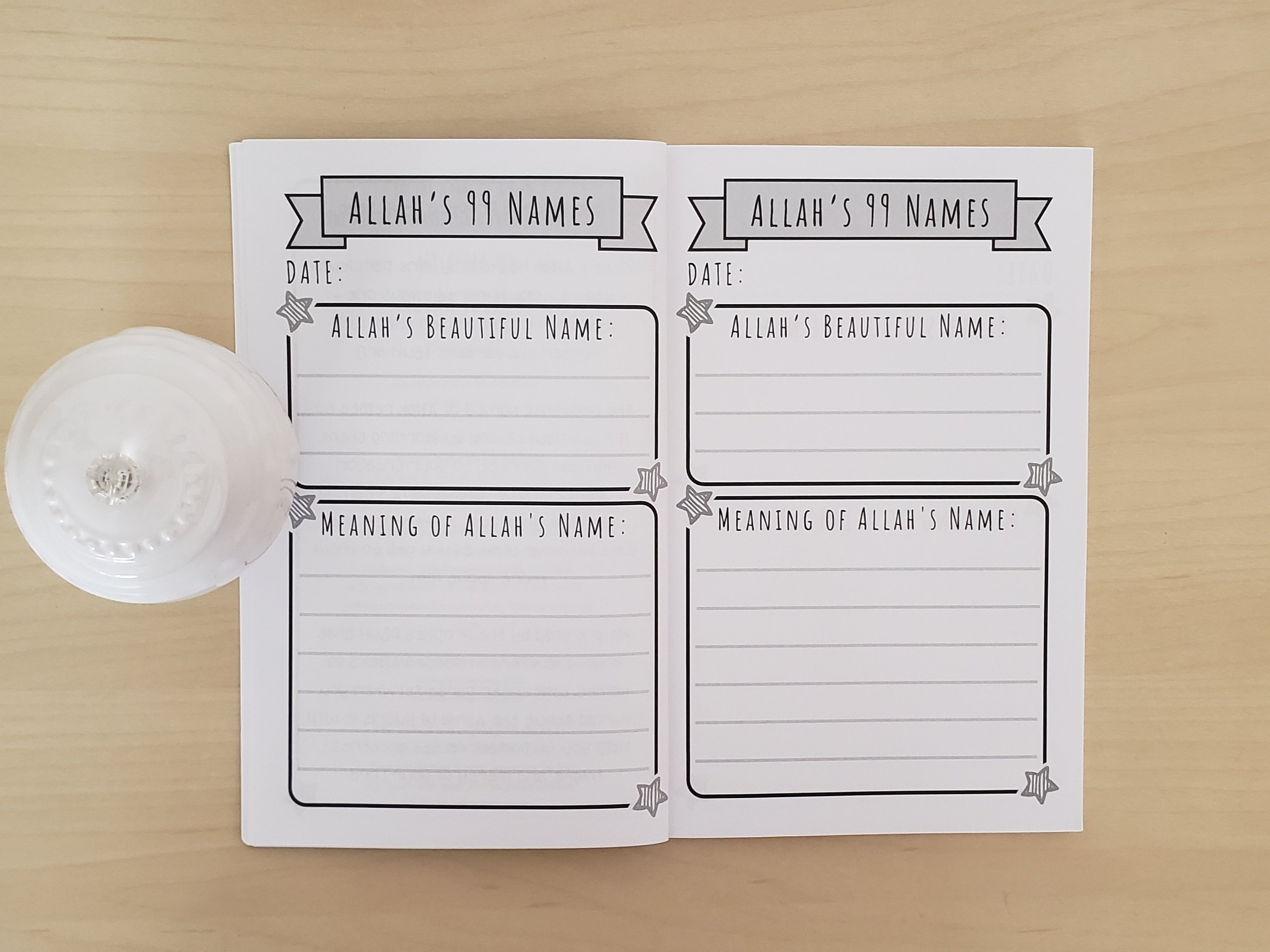
One of the most powerful and personal ways to learn the Names of Allah is through dedicated journaling by sitting together as a family, writing, reflecting, and decorating a page for each Name. I love this practice so much that I wrote an entire post dedicated to it. Head over to, How to Journal the Names of Allah With Your Kids, for the full step-by-step guide on how to make this a beautiful and consistent family practice inshallah.
5. Connect the Names to Everyday Life
This is what takes the Names from something your child learns to something your child lives. Bring the Names of Allah into your child's daily experiences naturally and consistently.
If your child shares something with a sibling, remind them: "Allah loves those who do good, and He is Ash-Shakoor, The Most Appreciative. He sees what you just did."
If they are afraid at night, reassure them: "Allah is Al-Hafeedh, The Protector. He is watching over you right now, even when I cannot be in your room."
If something good happens unexpectedly, say: "SubhanAllah, do you see how Allah provided for us? That is Ar-Razzaq, The Provider, taking care of our family."
Ask the question at dinner: "Where did you see [Name of Allah] today?" You will be amazed by what your children notice when they are actively looking for Allah in their day. This one practice alone can transform the spiritual atmosphere of your entire home.
6. Tips for Different Ages
Ages 3-5 — Keep it sensory and joyful
At this age, it is less about writing and more about experiencing. Say the Name together, clap it out, and draw a picture of what it means. "Al-Lateef means Allah is gentle. Can you draw something gentle?" A flower, a butterfly, a sleeping baby, or whatever they draw is perfect. The goal is simply association by connecting Allah's Name with a feeling of warmth and love.
Ages 6-8 — Simple writing with lots of creativity
Children at this age can begin writing the Name and its meaning with some guidance, and they love making things look nice. Encourage them to write one sentence about where they saw this Name of Allah during the week. Keep sessions to 15-20 minutes maximum.
Ages 9-12 — Deeper reflection and personal connection
Older children can go much deeper. Ask more probing questions like, "How does knowing Allah is Al-Hafeedh make you feel when you are scared?" or "How can you show Al-Kareem in your own life this week?" At this age, the learning can become genuinely transformative, and the conversations that come out of it will surprise and move you.
7. Celebrate Their Efforts
Children are motivated by recognition and celebration. When your child reaches a milestone, like memorizing 10 Names, 25 Names, 50 Names, make it a moment worth remembering.
Offer a small gift, a special outing, or a handwritten certificate of achievement. Throw a mini family celebration. Invite a grandparent to hear them recite. Write them a letter telling them how proud you are and how proud Allah SWT is of their effort.
And always remind them where the real reward lies: "The biggest reward is from Allah SWT Himself. He promised that whoever knows His Names will enter Jannah. You are working toward Jannah right now, and that is the most amazing thing."
8. Keep It Ongoing
Do not stop at memorization. Keep revisiting the Names, reviewing meanings, and incorporating them into family duas and daily conversations. Revisit the Names you learned months ago by asking, "Do you remember what Al-Jabbar means? Where did we see it this week?"
The Asma ul Husna is not a curriculum to complete, but a lifelong relationship to build. The goal is not a child who can recite 99 Names from memory. The goal is a child who, at fifteen, or twenty-five, or forty, still turns to Ar-Razzaq when they are worried about provision, still calls on Al-Hafeedh when they are afraid, still seeks At-Tawwab when they have made a mistake.
A Final Reflection
As parents, our goal is never to pressure our children but to gently guide them in loving Allah SWT. By making the 99 Names of Allah part of their learning, their play, their conversations, and their daily life, we give them a foundation of imaan that will carry them through everything this world brings.
May Allah SWT bless our efforts as mothers, make it easy for our children to learn His Beautiful Names, keep those Names in their hearts for life, and allow us all to enter Jannah through them. Ameen. 🤍
Salam, I’m Zakeeya!
A Muslim wife, mother of six, author, and mentor dedicated to helping Muslimas find peace, purpose, and barakah in their everyday lives. Since 2011, I've been sharing practical Islamic guidance on wifehood, motherhood, homemaking, and spirituality to help women like you navigate life's challenges with more faith and less overwhelm. If this post resonated with you, I'd love to have you join our community and say salam, grab free Islamic resources in the Member Vault, and explore my books, journals, and mentoring—visit my About Page. May Allah bless your journey! 🤍