How to Journal the Names of Allah With Your Kids: A Step-by-Step Guide
If you have not yet read my post, Teaching Your Kids the 99 Names of Allah: A Muslim Mother's Guide, start there first, as it covers all the different methods for teaching the Names in a broad and practical way. This post is the dedicated companion to that one, focused entirely and exclusively on one practice that I believe is transformative—journaling the Asma ul Husna together with your children.
I started this practice with my children a few years ago, and it became one of the most cherished things we did together. It is not elaborate or time-consuming, but actually quite simple. This post is your complete guide to making this practice happen in your home, inshallah.
Why Journaling Specifically?
There are many ways to teach children the Names of Allah by listening to recitations, flashcards, apps, conversations. All of them are valuable and I use all of them. But journaling does something that none of the others do.
It slows everything down.
In a world of constant speed and stimulation, sitting with one Name of Allah and truly thinking about it, writing it, reflecting on it, decorating it, making it personal, creates a depth of connection that passive learning simply cannot. The scholars tell us that ihsaa means not just to memorize, but to understand, internalize, and act upon. Journaling is the practice that builds all three of those things simultaneously.
And when you do it together with your children, side by side, each with their own journal, you add something else entirely. You add love, memory, and the image that will stay in your child's mind for the rest of their life of their mother sitting beside them, writing the Names of Allah with care and devotion.
The Journals We Use
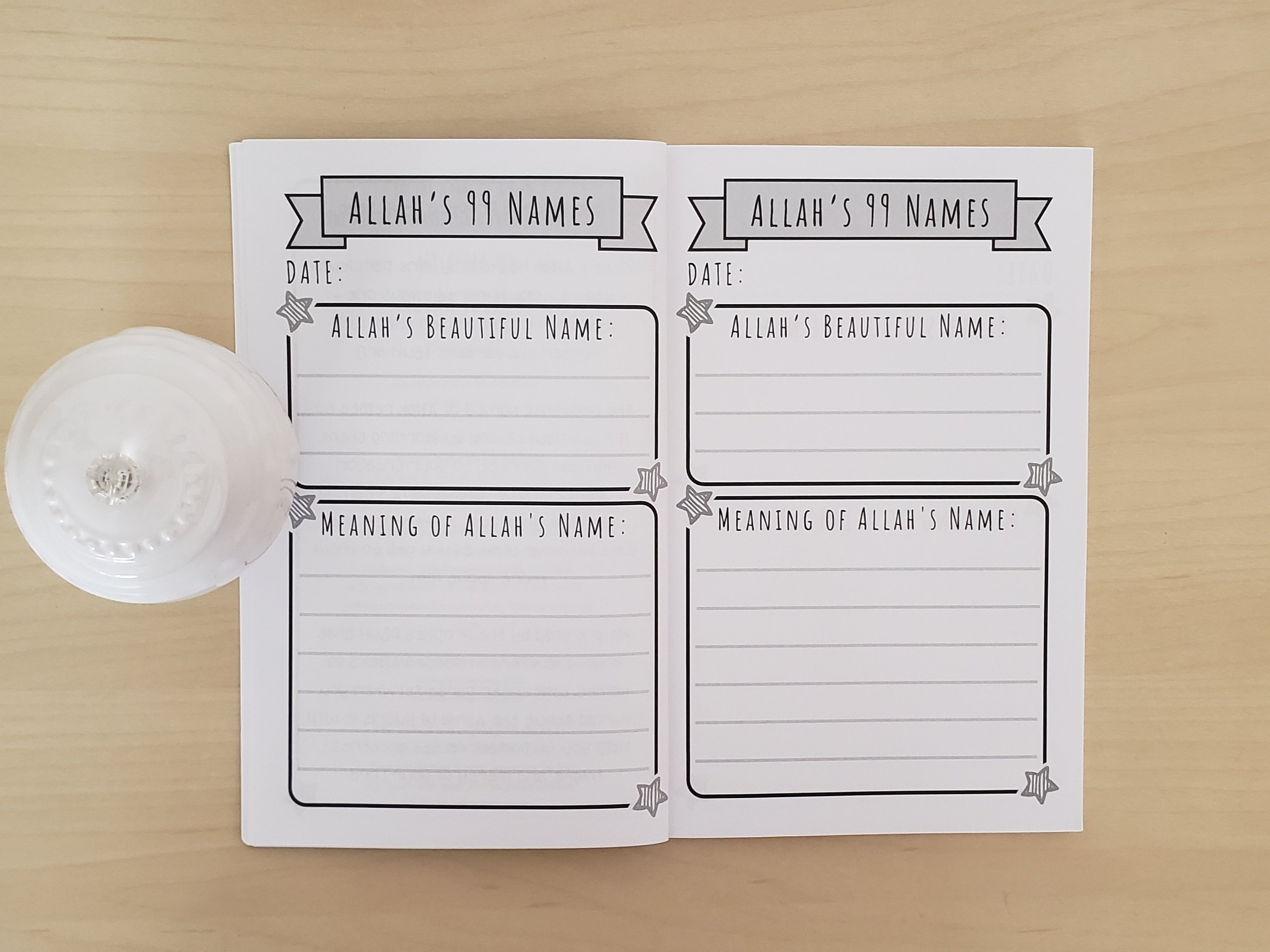
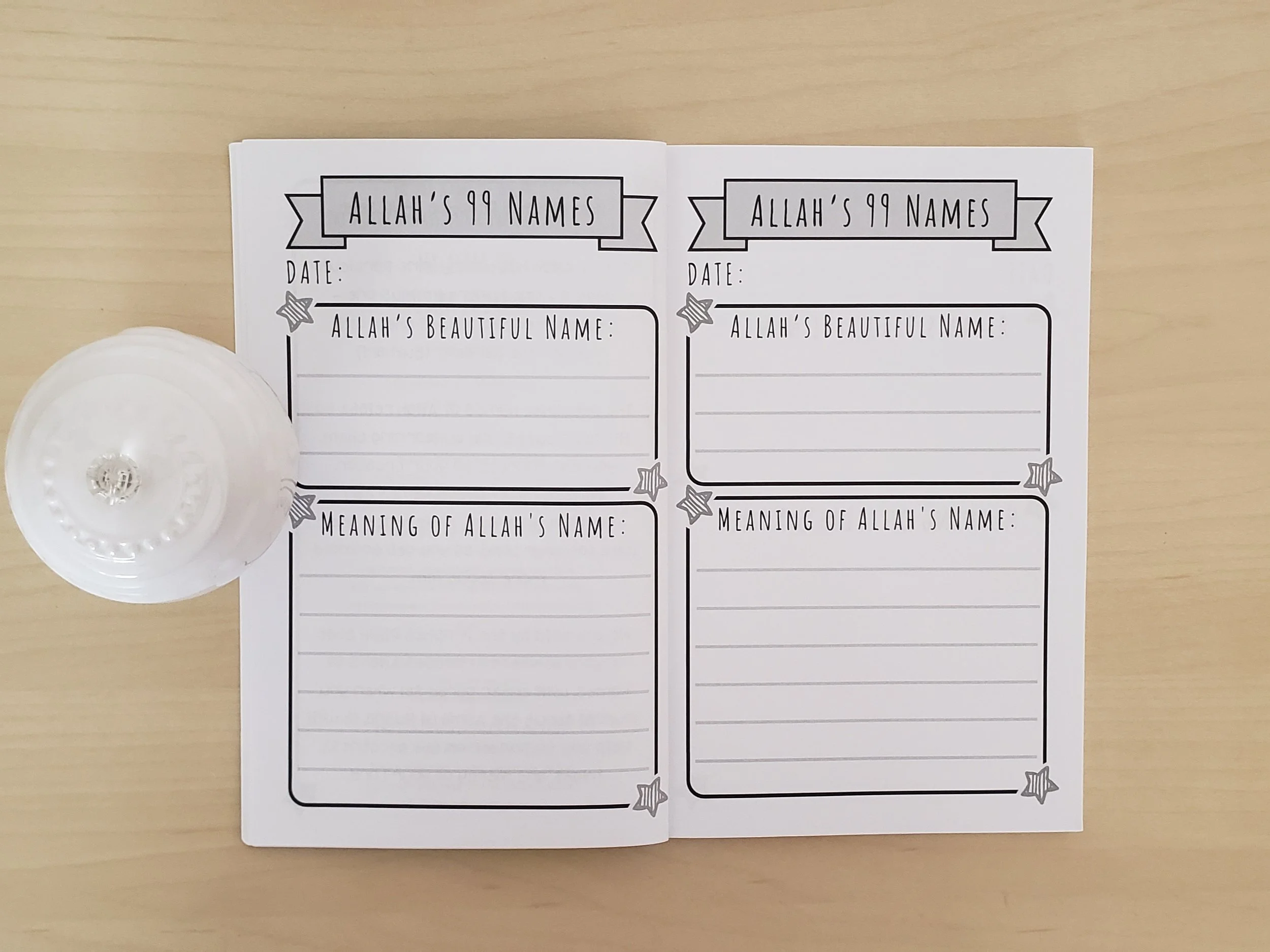
For my younger children, I used the My Asma ul Husna Journal, which is a journal I designed specifically for children ages 5-12 to learn and reflect on Allah's Beautiful Names. Each page focuses on one Name with sections for the child to write:
The Name of Allah in Arabic or transliteration
The meaning of the Name in their own simple words
Their favorite thing about that Name of Allah
Open space to decorate however they wish
The minimalist bullet journal design gives children complete creative freedom: stickers, colors, drawings, patterns, whatever makes the page theirs. When a child has decorated a page with their own hands, it becomes something personal to them. It is not a textbook. It is their book about their Lord. That distinction matters enormously.
I journaled alongside my children using the adult Asma ul Husna Journal, which is the same structured approach designed for adults and older kids. We sit together, open our journals at the same time, and work through the same Name side by side.
When to Journal
1. Weekly is the happy medium
Friday is the most blessed day of the week, and making this a Friday family ritual gives it a sacred, special quality that children respond to deeply. After Jumuah salah or in the evening, you can sit together with your journals and dedicate this time to one Name of Allah. Children love rituals, so when Friday becomes the family journaling day, they will start reminding you, inshallah!
2. Two to three times per week if you can manage it
Even five minutes of "What Name of Allah did we learn this week? Where did you see it today?" reinforces the learning beautifully without requiring a full session every day. I was able to do this task more often when we homeschooled, as it was part of our school syllabus.
3. Ramadan is especially nice
The atmosphere of the month makes children naturally more spiritually receptive. Consider doing one Name every day during Ramadan as a special family challenge, and by the end of the month, you will have covered nearly 30 Names together, mashallah! Or if you want to be ambitious, do three to four Names per day and accomplish all 99, alhamdulillah!
4. Host or join a journal craft playdate
You can host a playdate with other homeschooling moms or on weekends with the school-goers, and make it a time for journaling and crafting together. You can take turns with other moms to host it weekly or monthly so the burden is not only on your shoulders. This is such a beautiful idea for children to learn Allah’s Names while doing arts and crafts and socializing.
How to Run Each Journaling Session — Step by Step
Step 1 — Open with Bismillah and a short dua
Begin every session the same way. Say Bismillah together and make a short opening dua like:
"Ya Al-Aleem, teach us what we do not know. Ya Al-Lateef, open our hearts to understanding Your Names. Ya Al-Wadood, let this time together draw us closer to You. Ameen."
This simple opening signals to your child that what follows is not just an activity, but also an act of worship.
Step 2 — Introduce the Name
Say the Name out loud together three times, clearly and beautifully. Then explain what it means in warm, simple, child-friendly language, not a textbook definition but your own explanation.
For Al-Kareem, you might say: "Al-Kareem means Allah is the Most Generous. He gives us everything we have—our food, our home, our family, our health—and He never runs out of things to give. He gives even when we forget to say thank you. That is how generous He is."
Ask your child to repeat the Name and its meaning back to you in their own words. This step will help deepen retention.
Step 3 — Share where you saw this Name
Before anyone opens their journal, have a conversation and ask something like: "Where did you see this Name of Allah this week?"
Give them time. Do not rush this. A younger child might need a gentle prompt like, "Did Allah give us anything generous this week? What did we have for dinner? Who gave us that food?" An older child might surprise you with something that moves your heart.
Then share your own answer too. When your child hears you say, "I saw Al-Kareem today when someone helped me unexpectedly, and I thought that was Allah's generosity reaching me through that person," they see that this is not a children's exercise. It is something their mother lives and means.
Step 4 — Open the journals and write
Now open your journals together. You in yours, them in theirs. Write at the same time. This simultaneity is important because it makes it a shared experience rather than a supervised one.
Let them write the Name in Arabic if they can, or in transliteration if Arabic is still developing. The meaning in their own words, not copied but understood. And then their favorite thing about this Name, which is often the most valuable thing they write.
Do not rush their handwriting or redirect their decorating. The page is theirs, and the more ownership they feel over it, the more it will mean to them now and years from now when they look back at it.
Step 5 — Decorate
This is the part children love most, and it is not frivolous but intentional. When a child spends time making a page about Allah’s Name beautiful, they are expressing love for Him through their hands. They are saying with their colors and stickers and drawings: this Name of my Lord is worth making beautiful.
Let them go completely free here. Stickers, washi tape, colored pens, drawings, patterns, whatever they want, as long as it is respectful and honoring. Some children will spend ten minutes, while some will spend more, and that’s perfectly fine.
Step 6 — Close with a dua using the Name
End every session the same way, with a short dua using the Name you learned together. Keep it simple and let your child repeat after you, something like:
"Ya Al-Kareem, thank You for being so generous to our family. Help us be generous to others, too, and make us grateful for everything You give us. Ameen."
When a child closes a journaling session by calling on Allah by the Name they just wrote and decorated and reflected on, the practice is complete. The knowing, the feeling, and the calling on Him all come together in one moment.
Keeping the Name Alive Between Sessions
The journaling session is the anchor, but the practice lives in the days between. Here are simple ways to keep each Name relevant throughout the week:
The journal stays open
Leave the current page open on the kitchen counter or a visible spot during the week. Every time someone passes it, say the Name once.
The dinner table question
Every evening, maybe at dinner, ask: "Where did you see [Name of Allah] today?" This keeps the Name active in your child's mind and teaches them to read their day through the lens of Allah's attributes.
Catch the moments
When something happens during the week that reflects the Name you are learning, say it out loud immediately. "SubhanAllah, do you see what just happened? That is Al-Fattah, The Opener, working in our lives." You are training your child's eyes to see Allah everywhere, and that is one of the greatest gifts a mother can give her child.
Making It a Lifelong Practice
Dear fellow mom, what you are building with this journaling practice is not a childhood activity that your children will grow out of. You are building a habit of the heart, of sitting with Allah's Names, reflecting on them, and letting them shape the way you see your life.
My hope and my dua is that one day your child will be an adult, perhaps a parent themselves, and they will still have their childhood Asma ul Husna journal on their shelf. They will open it and see their seven-year-old handwriting next to a drawing or sticker of a flower on the page for Ar-Rahman. And they will feel, in that moment, the love of a mother who sat beside them and taught them who their Lord is.
Of course, feel free to tweak this activity to suit your time and your curriculum. This is also a wonderful activity for a teacher to do with her class for Islamic studies, or a homeschool mom to implement with her kids.
May Allah SWT bless every session you share with your children, accept it as an act of worship, and make it a means of closeness to Him for your entire family in this life and the next. Ameen. 🤍
Get the Journals
My Asma ul Husna Journal for Kids — designed for children ages 5-12 with structured pages to write, reflect on, and decorate each of Allah's 99 Names
The Asma ul Husna Journal for Adults and Teens — the adult companion journal to use alongside your children
Salam, I’m Zakeeya!
A Muslim wife, mother of six, author, and mentor dedicated to helping Muslimas find peace, purpose, and barakah in their everyday lives. Since 2011, I've been sharing practical Islamic guidance on wifehood, motherhood, homemaking, and spirituality to help women like you navigate life's challenges with more faith and less overwhelm. If this post resonated with you, I'd love to have you join our community and say salam, grab free Islamic resources in the Member Vault, and explore my books, journals, and mentoring—visit my About Page. May Allah bless your journey! 🤍
Get Support For Your Struggles

You don’t need to suffer alone
Life’s tough, but so are you. You simply need direction and help from someone experienced, empathetic, and understanding.