Beware of “Pink Cherry Islam”: The New Online Fitna Targeting Muslim Women

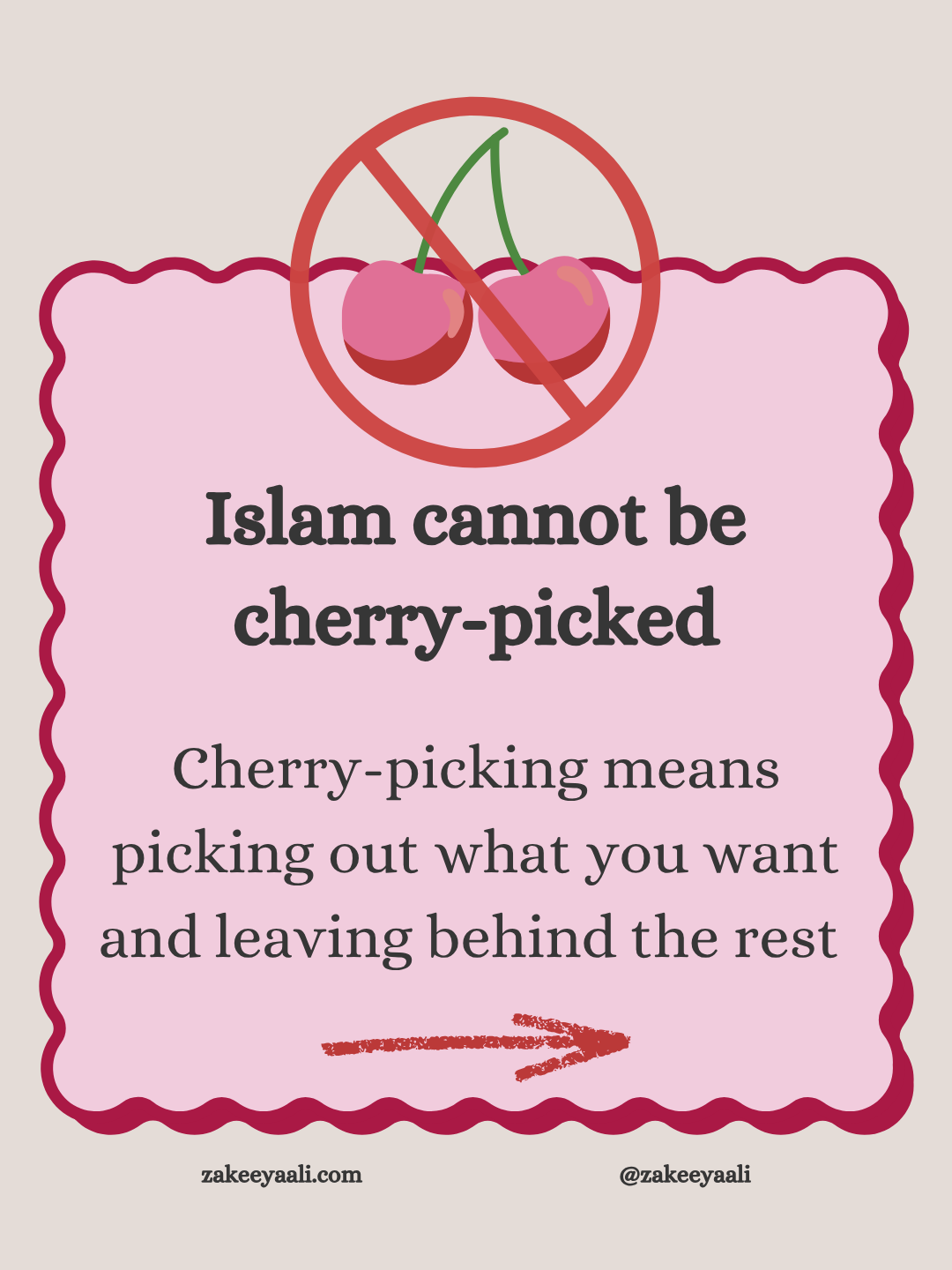
There is a new trend circulating online that has been referred to as “Pink Cherry Islam.” This is the idea of cherry-picking parts of Islam you like while leaving behind the parts you do not agree with. It is particularly targeted towards Muslim women, marriage, gender roles, and the rights and responsibilities of husbands and wives.
“Pink Cherry Islam” is a term being used online to describe a skewed mindset and collection of beliefs. Some of the ideas associated with this trend are Hadith denial and Quran-only Islam, where the Sunnah is rejected or significantly diminished. Rejecting the Sunnah as an authoritative source of Islam is a serious matter because Allah SWT commanded us to obey His Messenger SAW.
The problem with cherry-picking Islam is that we cannot take the parts of Islam that agree with us and reject the parts that challenge us. Islam is not something we get to customize according to our personal preferences, past traumas, modern culture, or what happens to be popular on social media.
Islam Is About Submission
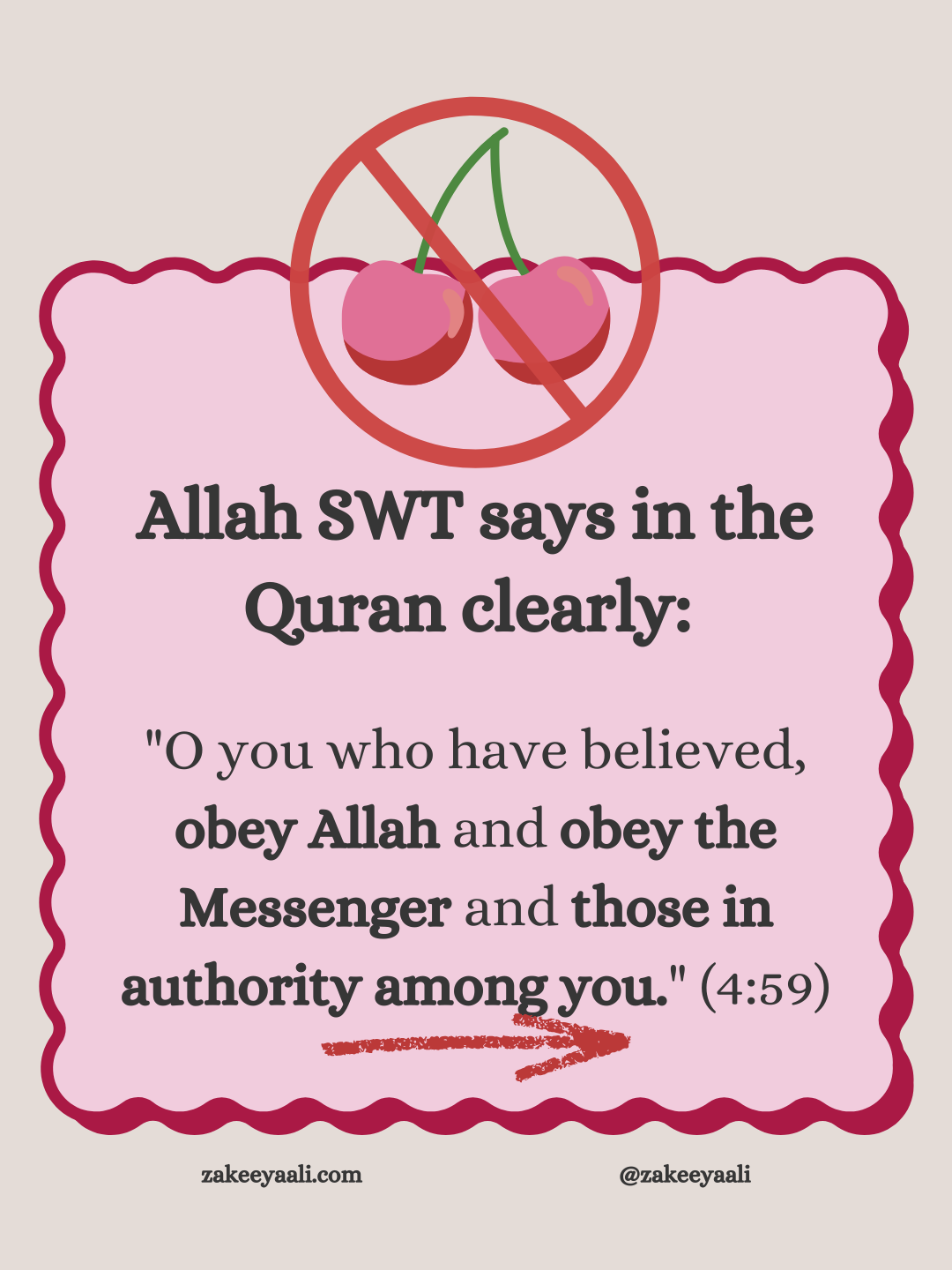
Islam is submission to the Will of Allah. It means that when Allah SWT tells us something, our response as believers should ultimately be, “I hear, and I obey,” even when something is difficult for our nafs. Allah SWT says,
“O you who have believed, obey Allah and obey the Messenger and those in authority among you.” (4:59)
Notice that Allah SWT did not tell us to obey Him only when we agree with what He has commanded. Our iman is tested when something requires us to put our desires aside and submit to what our Lord has revealed.
This is where cherry-picking becomes dangerous. We may love the teachings of Islam about mercy, kindness, justice, and compassion, but then become uncomfortable when Islam teaches us about modesty, obedience, marriage, family responsibilities, sacrifice, or the differences between men and women. We cannot accept Islam only when it confirms what we already believe.
Islam is supposed to shape our beliefs, not our beliefs reshape Islam.
What About the Hadith?
This is where the Quranist and Hadith-denying aspect of this movement becomes particularly concerning. There is an important difference between questioning whether a particular Hadith is authentic and rejecting Hadith altogether. Muslims have always had a sophisticated science of Hadith authentication, and scholars spent generations examining narrators, chains of transmission, wording, and other factors to determine what could reliably be attributed to Rasulullah SAW.
But some people today go much further and say that we should follow only the Quran and do not need the Hadith or Sunnah. The problem with this is that the Quran itself commands us to follow and obey Rasulullah SAW. Allah SWT says,
“Whoever obeys the Messenger has indeed obeyed Allah.” (4:80)
Allah SWT also says,
“And We revealed to you the message so that you may explain to the people what was sent down to them.” (16:44)
So how can we say that the Messenger's explanation and example are unnecessary when Allah SWT Himself tells us to obey him?
The Quran tells us to establish salah, but it is the Sunnah that teaches us how Rasulullah SAW prayed. The Quran commands us to perform Hajj, but Rasulullah SAW demonstrated how to perform it. The Quran gives us principles concerning marriage, family, worship, manners, and countless other matters, while the Sunnah gives us the practical example of how those teachings are lived.
You cannot separate Rasulullah SAW from the revelation he was sent to teach.
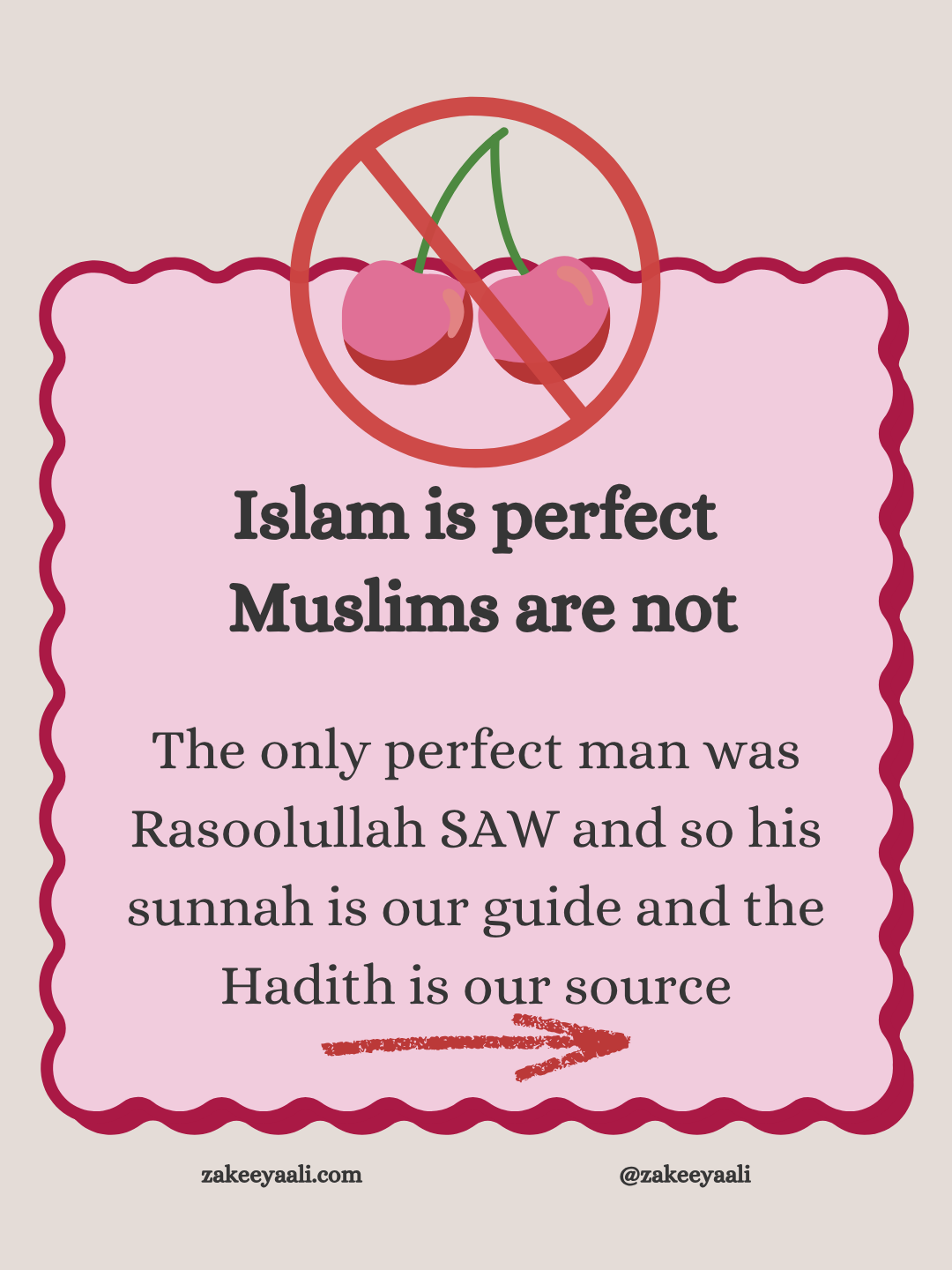
Islam Is Perfect, Muslims Are Not
Another thing we need to remember is that Islam is perfect, but Muslims are not.
Muslim men make mistakes. Muslim women make mistakes. Husbands can be unjust, and wives can be unjust. Parents can fail their children, and children can fail their parents. There are Muslims who behave terribly and Muslims who behave beautifully.
None of this changes the truth of Islam.
We should never take the bad behavior of a Muslim man and use it as evidence that Islam is wrong. At the same time, we should not excuse a Muslim woman's behavior simply because we are sympathetic to her situation. We have to learn to separate the religion from the behavior of the people who claim to follow it.
Our standard is not another Muslim. Our standard is the Quran and Sunnah.
Men and Women Are Equal, But Not Identical
A great deal of the modern conversation surrounding Islam and women seems to assume that if men and women have different roles, responsibilities, or characteristics, then women must somehow be inferior.
That is not what Islam teaches.
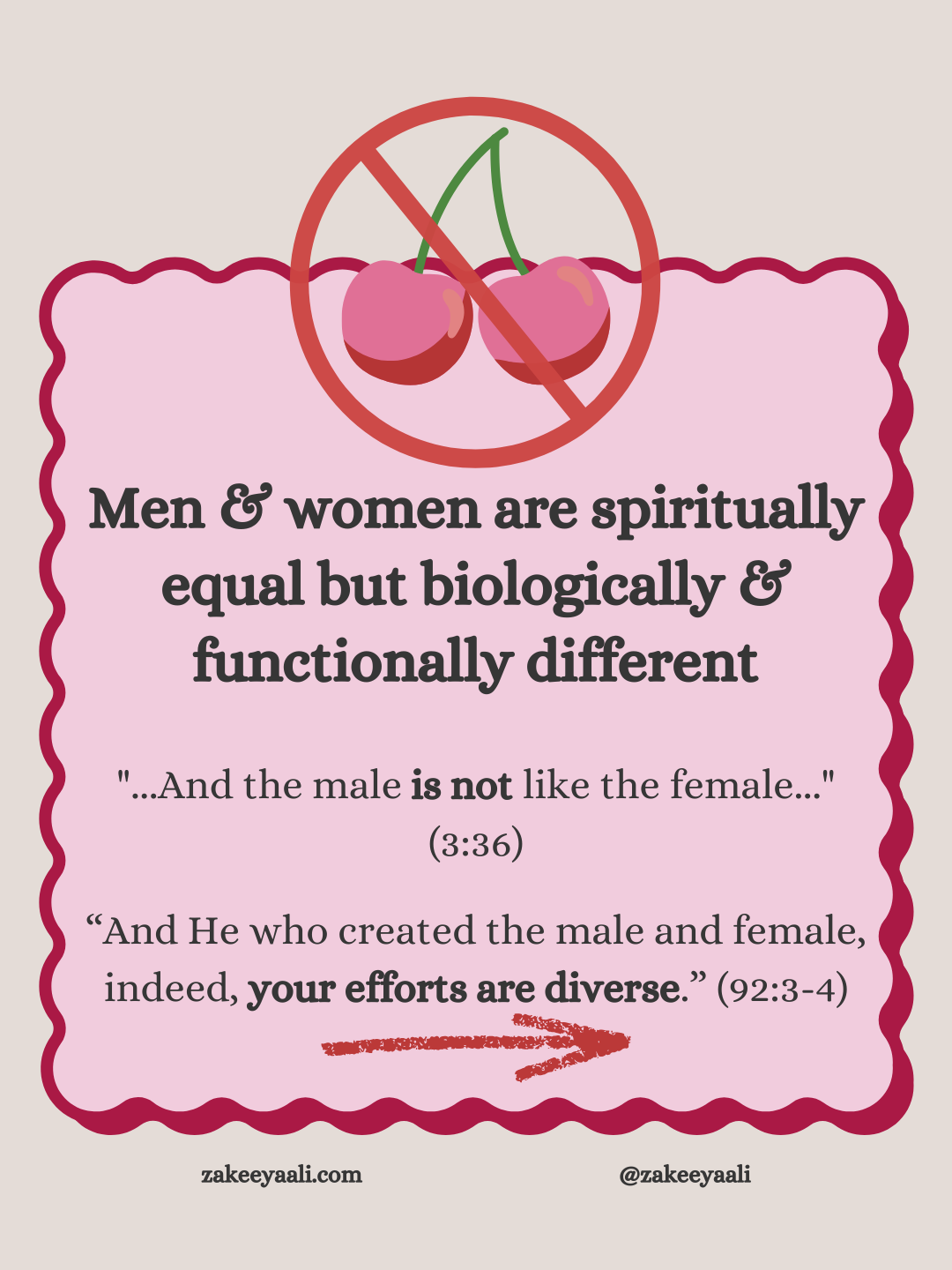
Men and women have equal human worth before Allah SWT and are equally capable of earning His pleasure, but equality does not mean that Allah SWT created men and women to be identical. We have different bodies, different biological functions, and different natural characteristics, and Islam recognizes these differences. Allah SWT says,
“…And the male is not like the female…” (3:36).
Allah SWT also says,
“And He who created the male and female, indeed, your efforts are diverse.” (92:3-4)
There is nothing degrading about acknowledging that men and women are different. In fact, pretending that we are exactly the same does not honor the way Allah SWT created us.
A woman does not have to become like a man to have dignity. She does not have to reject motherhood, marriage, femininity, modesty, or the responsibilities Allah SWT has given her in order to prove that she is valuable.
Her value comes from Allah SWT.
Men and Women Are Not Enemies
This is another area where I think Muslim women need to be careful. We should never allow legitimate discussions about women's rights or problems in Muslim communities to turn into a general hatred or suspicion of men.
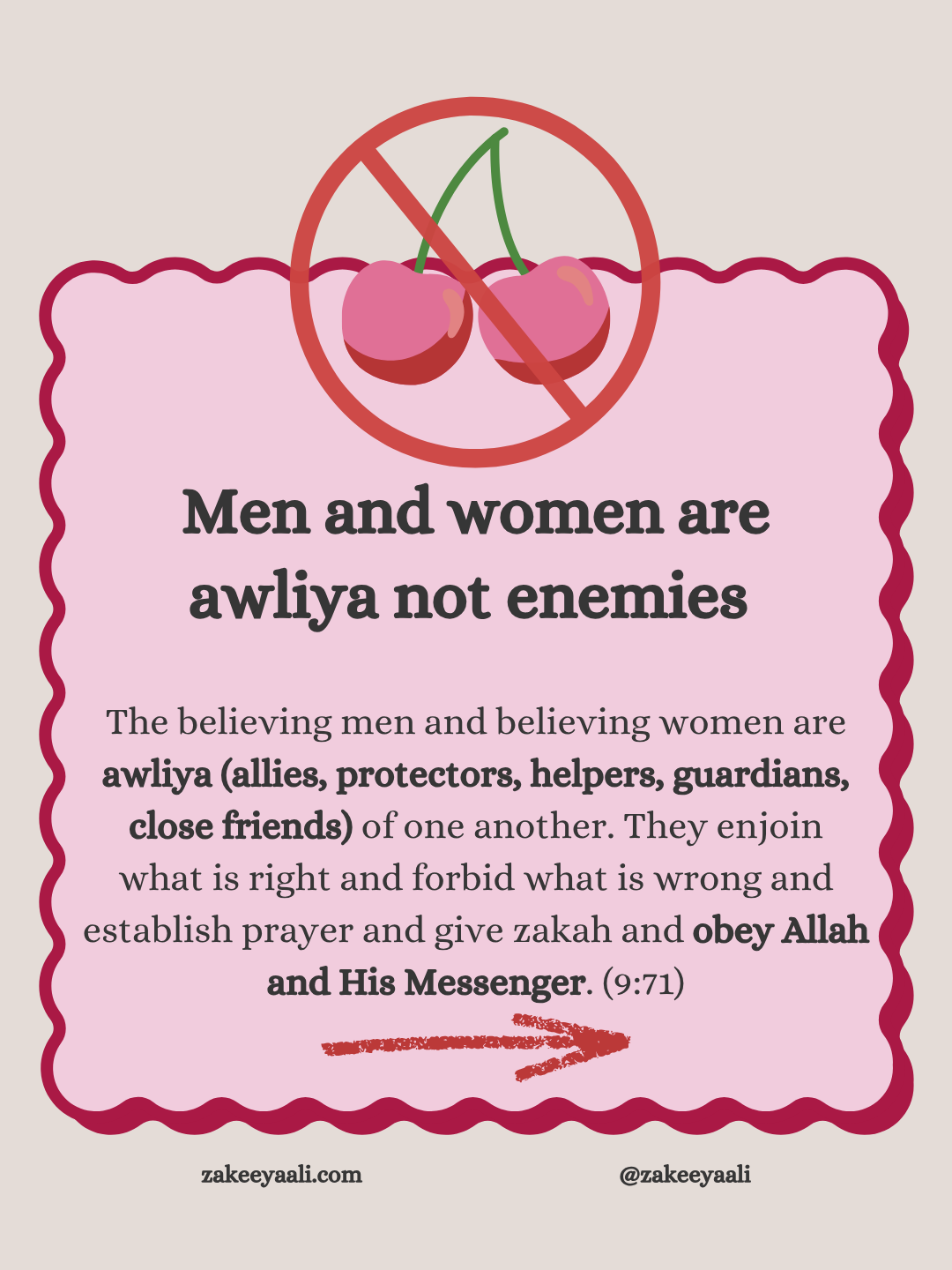
Islam does not teach that men and women are enemies. Allah SWT says,
“The believing men and believing women are awliya of one another. They enjoin what is right and forbid what is wrong and establish prayer and give zakah and obey Allah and His Messenger.” (9:71)
The believing men and believing women are awliya, allies, protectors, helpers, guardians, and close supporters of one another.
That is a beautiful description of the relationship between believing men and women. We are supposed to help each other obey Allah SWT, not spend our lives trying to defeat each other.
This is especially important in marriage. Your husband should not be viewed as your enemy simply because Allah SWT gave him responsibilities that are different from yours. Likewise, a husband should never view his wife as someone beneath him simply because Allah SWT gave him a position of responsibility within the family.
Different does not mean better or worse.
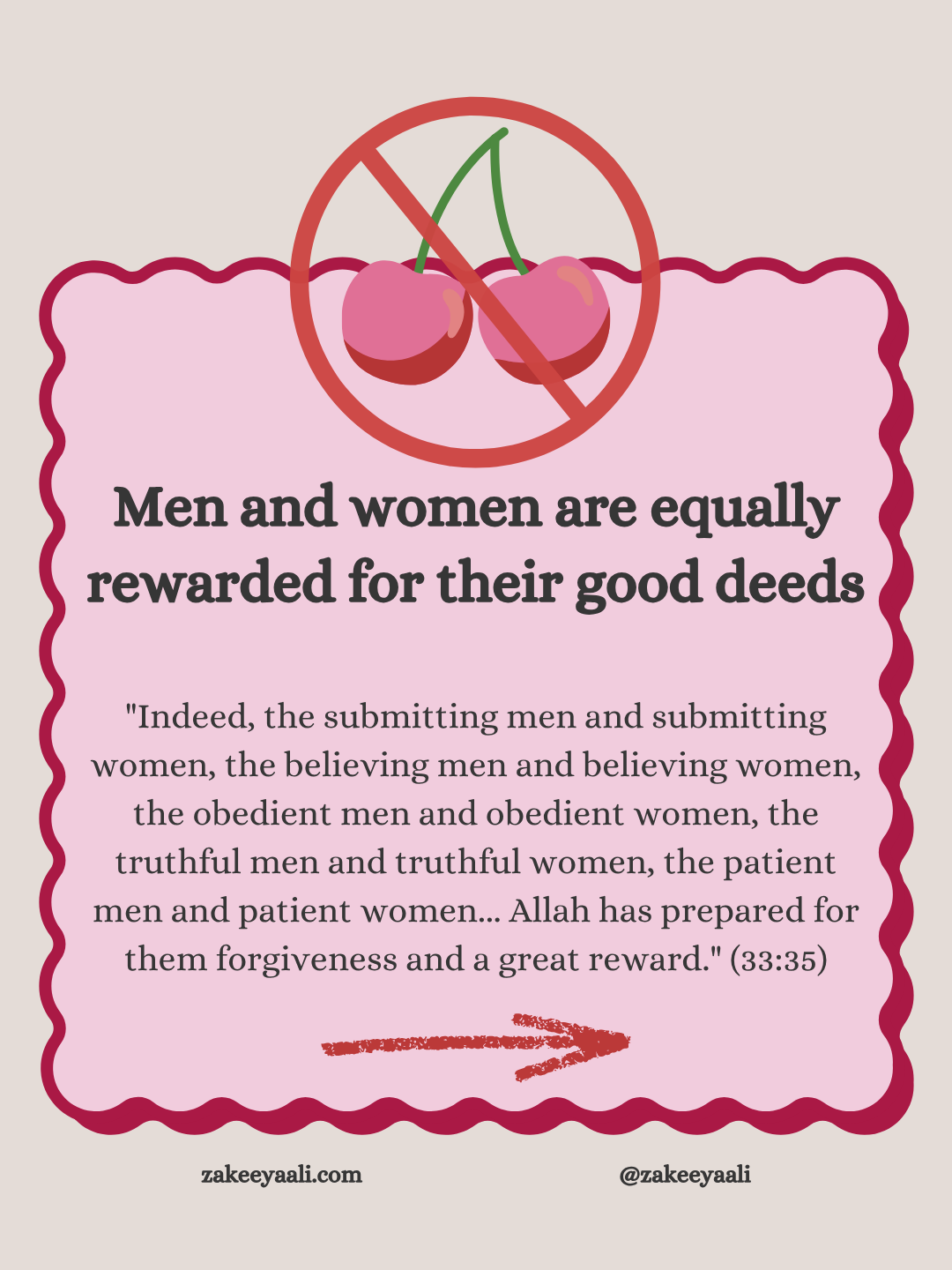
Men and Women Are Equally Rewarded
Allah SWT makes this very clear in the Quran when He describes the qualities that lead to forgiveness and reward. He repeatedly mentions men and women together. Allah SWT says,
“Indeed, the submitting men and submitting women, the believing men and believing women, the obedient men and obedient women, the truthful men and truthful women, the patient men and patient women... Allah has prepared for them forgiveness and a great reward.” (33:35)
A woman does not have to compete with a man to prove that she is worthy before her Lord. She does not need to have exactly the same role as a man to have the same opportunity for Jannah.
Likewise, being a man does not automatically make someone righteous. Both men and women are tested, both are commanded to obey Allah SWT, and both will stand before Him.
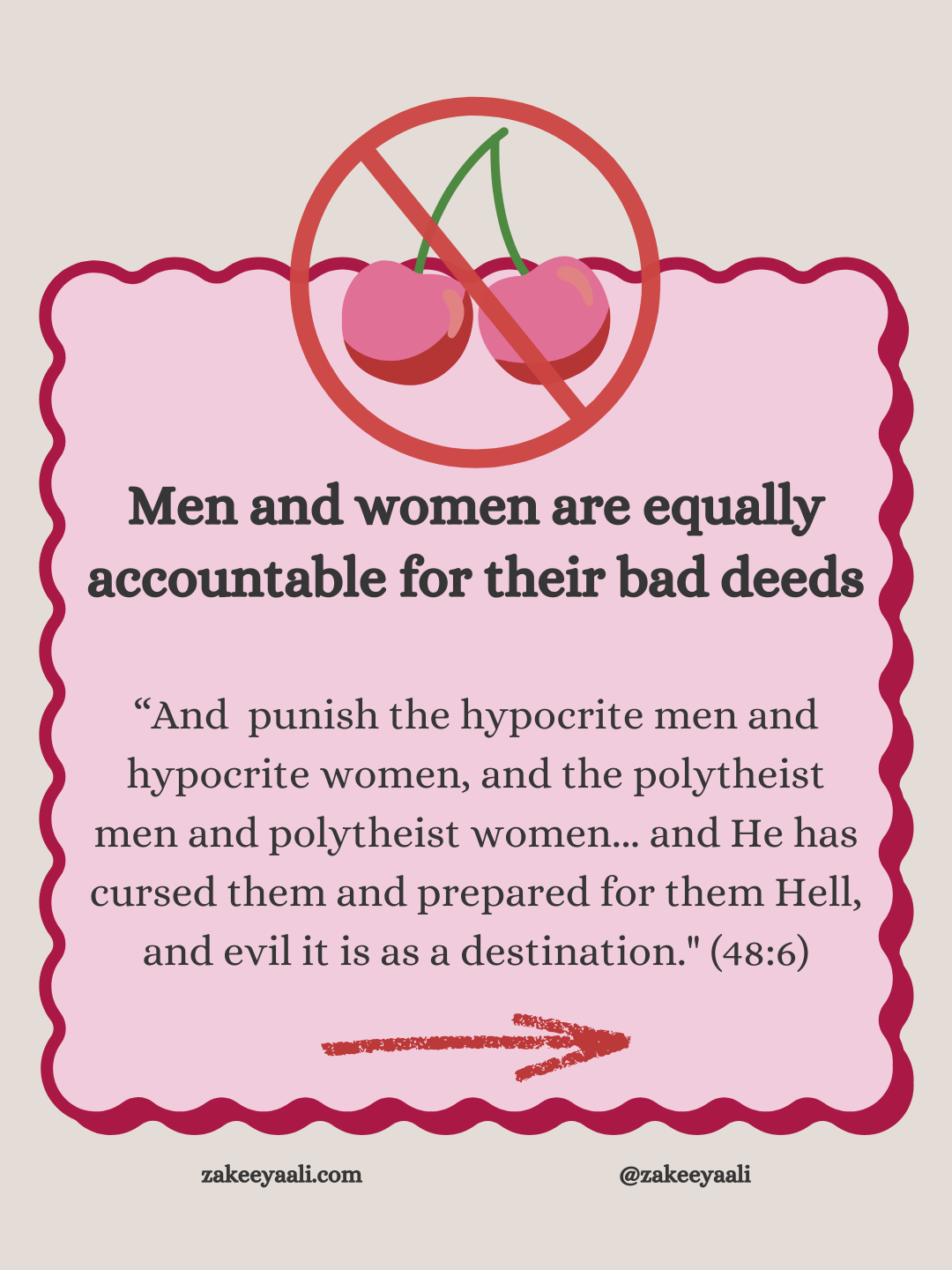
Men and Women Are Equally Accountable
The same is true when it comes to sin. Men are accountable for their actions, and women are accountable for theirs. Allah SWT says,
“And punish the hypocrite men and hypocrite women, and the polytheist men and polytheist women... and He has cursed them and prepared for them Hell, and evil it is as a destination.” (48:6)
This is something that can easily get lost when conversations about men and women become focused entirely on who is responsible for what.
Yes, husbands have responsibilities and wives have responsibilities. Fathers have responsibilities and mothers have responsibilities. But ultimately, every one of us is responsible for our own relationship with Allah SWT.
Instead of constantly asking, “What is supposed to be done for me?” we should be asking, “What does Allah SWT expect from me?” That question changes everything.
When Women's Rights Become the Entire Conversation
There is nothing wrong with Muslim women learning their rights. In fact, I believe women should know their rights and should never tolerate genuine oppression or abuse.
But there is a difference between knowing your rights and making your entire understanding of Islam revolve around your rights.
We can become so focused on what our husband owes us that we forget to think about what we owe him. We can become so focused on what men should do differently that we stop examining our own behavior. We can become so focused on avoiding being taken advantage of that we forget the reward that comes with patience, generosity, forgiveness, and sacrifice for the sake of Allah SWT.
Marriage is not supposed to be a constant accounting system where a husband keeps track of everything his wife owes him and a wife keeps track of everything her husband owes her.
Marriage is an amanah.
There are rights, but there are also responsibilities. There is authority, but there is also accountability. There is obedience, but there is also mercy. There is sacrifice from both people, and there are times when one spouse will have to carry more than the other. This is what family life requires.
How Cherry-Picked Islam Can Harm Muslim Women
I believe this is particularly dangerous for Muslim women because much of this messaging is packaged as empowerment.
There is nothing wrong with wanting to be educated, respected, financially secure, protected from abuse, or treated with dignity. Islam itself gives women rights and honors women.
The problem begins when we start labeling every responsibility as oppression and every sacrifice as exploitation.
Motherhood requires sacrifice. Marriage requires sacrifice. Caring for aging parents requires sacrifice. Serving others requires sacrifice. Even our worship requires sacrifice because sometimes we have to put aside what we want in order to do what Allah SWT has commanded.
Not every difficult thing is oppression. Sometimes it is simply life. And sometimes it is worship.
When a woman is constantly taught to ask, “What am I getting out of this?” she can slowly lose the understanding that some of the most beautiful things we do are acts of worship precisely because they require us to give.
We should want to be good wives because Allah SWT loves goodness. We should want to be good mothers because our children are an amanah. We should want to care for our families because serving those we love can be an act of worship.
That does not mean accepting abuse or injustice. It means learning the difference between sacrifice and oppression.
How It Can Damage Marriage
When men and women are taught to see one another as opponents, marriage becomes a competition.
The wife is keeping a list of everything her husband is doing wrong, while the husband is keeping a list of everything his wife is doing wrong. Both are demanding their rights, but neither is thinking about their responsibilities.
That is not the tranquility Allah SWT intended for marriage.
Marriage needs cooperation. It needs mercy, forgiveness, and patience. It needs two imperfect people who are willing to grow and who understand that they are ultimately accountable to Allah SWT.
A husband should want his wife to enter Jannah and a wife should want her husband to enter Jannah. That changes how you look at one another. You stop asking, “How can I win?” and start asking, “How can we help each other become better Muslims?” That is the kind of thinking our marriages need.
Our Children Are Watching
What we teach our children about men, women, marriage, and Islam matters.
If our daughters constantly hear that men cannot be trusted, they may grow up viewing marriage with suspicion. If our sons constantly hear that women are manipulative or demanding, they can develop their own unhealthy attitudes toward women.
Children need to see that men and women have different responsibilities but can still love, respect, support, and protect one another.
They need to see their parents working together rather than fighting over who has more power. They need to learn that Islam is not a battle between husbands and wives. Rather, it is a way of life that teaches us how to worship Allah SWT and how to treat the people around us.
Do Not Let Social Media Become Your Source of Islam
I encourage Muslim women to be very careful about what they consume online. Not everyone with a platform is qualified to teach Islam, and not every person quoting a verse understands the context or the traditional interpretation of that verse.
We have access to more information than ever before, but access to information is not the same thing as having knowledge.
If someone tells you that you do not need Hadith, investigate that claim. If someone tells you that the Sunnah is outdated, go back to the Quran and see what Allah SWT says about obeying His Messenger SAW. If someone gives you an interpretation of Islam that sounds suspiciously like whatever happens to be popular in modern culture, take the time to investigate it properly.
And pay attention to what the content is doing to your heart. Are you becoming closer to Allah SWT? Are you becoming more humble, patient, grateful, responsible, and obedient? Or are you becoming angry, resentful, suspicious, and constantly dissatisfied with your husband, your family, men, or your life? Not everything that makes you feel empowered is good for your iman.
We Cannot Redesign Islam
At some point, we have to be willing to admit that our desires can get in the way of our understanding. If we accept a teaching because we like it but reject another because we do not like it, we are no longer allowing Islam to guide us. We are using our preferences to decide which parts of Islam we will follow.
That should make every one of us pause.
The nafs will always prefer the path that requires less from us. It is much easier to find an explanation for why we do not have to change than it is to admit that we need to change.
But Islam came to transform us. We are not supposed to transform Islam into whatever version makes us comfortable. Allah SWT says,
“But no, by your Lord, they will not truly believe until they make you, [O Muhammad], judge concerning that over which they dispute among themselves and then find within themselves no discomfort from what you have judged and submit in full, willing submission.” (4:65)
Protect Your Iman and Your Family
We should not be afraid to ask questions about Islam. We should learn, research, and seek knowledge. But we need to make sure that our sources are trustworthy and that we are learning from the Quran, authentic Sunnah, and qualified scholars rather than allowing social media influencers to become our teachers.
Be especially careful when someone encourages you to reject a teaching simply because it makes you uncomfortable. Be careful when someone tells you that Hadith are unnecessary. Be careful when someone consistently encourages resentment between men and women. And be careful when someone presents a version of Islam where all of the responsibilities belong to everyone else while your own responsibilities seem to disappear.
That is not empowerment. True empowerment for a Muslim woman is knowing her deen well enough that she does not need to choose between being a strong woman and being an obedient servant of Allah SWT.
You can know your rights and still fulfill your responsibilities. You can recognize injustice without hating men. You can have boundaries without rejecting marriage. You can have a voice without rejecting obedience to Allah SWT. You can be feminine without being weak, and you can be strong without becoming hard-hearted.
Most importantly, you can live confidently knowing that Allah SWT created you as you are and that your greatest honor is not found in proving yourself to the world. It is found in your relationship with Him.
Ask Allah SWT to Keep Your Heart Firm
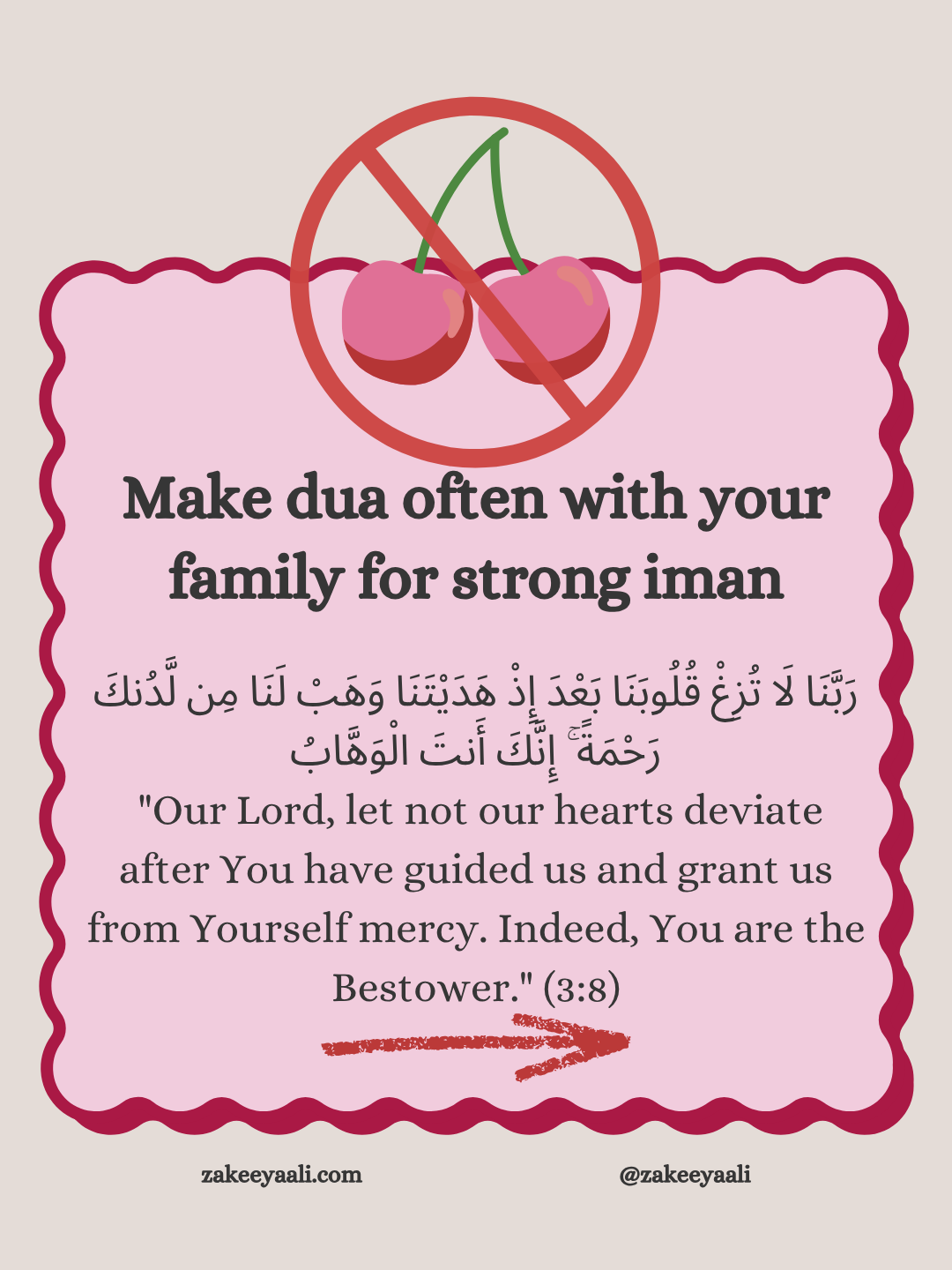
With so much confusion surrounding Islam today, we need to ask Allah SWT to protect us from being led astray. None of us should become so confident in our own understanding that we forget that guidance is a gift from our Lord. Allah SWT gives us this beautiful dua:
“Our Lord, let not our hearts deviate after You have guided us and grant us from Yourself mercy. Indeed, You are the Bestower.” (3:8)
Make this dua for yourself, for your husband, and for your children. Make it for our daughters and our sons, and for the ummah.
We do not need a new version of Islam that conforms to whatever ideas are popular today. We need to understand the Islam Allah SWT revealed and follow the example of Rasulullah SAW.
Islam is not cherry-picked; it is submitted to.
And when we submit to Allah SWT, we may discover that the parts of Islam we once struggled to understand were not there to diminish us at all. They were there to guide us toward what is better for our iman, our relationships, our families, and our lives.
Salam, I’m Zakeeya!
A Muslim wife, mother of six, author, and mentor dedicated to helping Muslimas find peace, purpose, and barakah in their everyday lives. Since 2011, I've been sharing practical Islamic guidance on wifehood, motherhood, homemaking, and spirituality to help women like you navigate life's challenges with more faith and less overwhelm. If this post resonated with you, I'd love to have you join our community and say salam, grab free Islamic resources in the Member Vault, and explore my books, journals, and mentoring—visit my About Page. May Allah bless your journey! 🤍